Skeleton
6s on one page-wide clock. When loaded, the same threshold sweeps once and swaps placeholder for content cell by cell, the front cells in the accent.
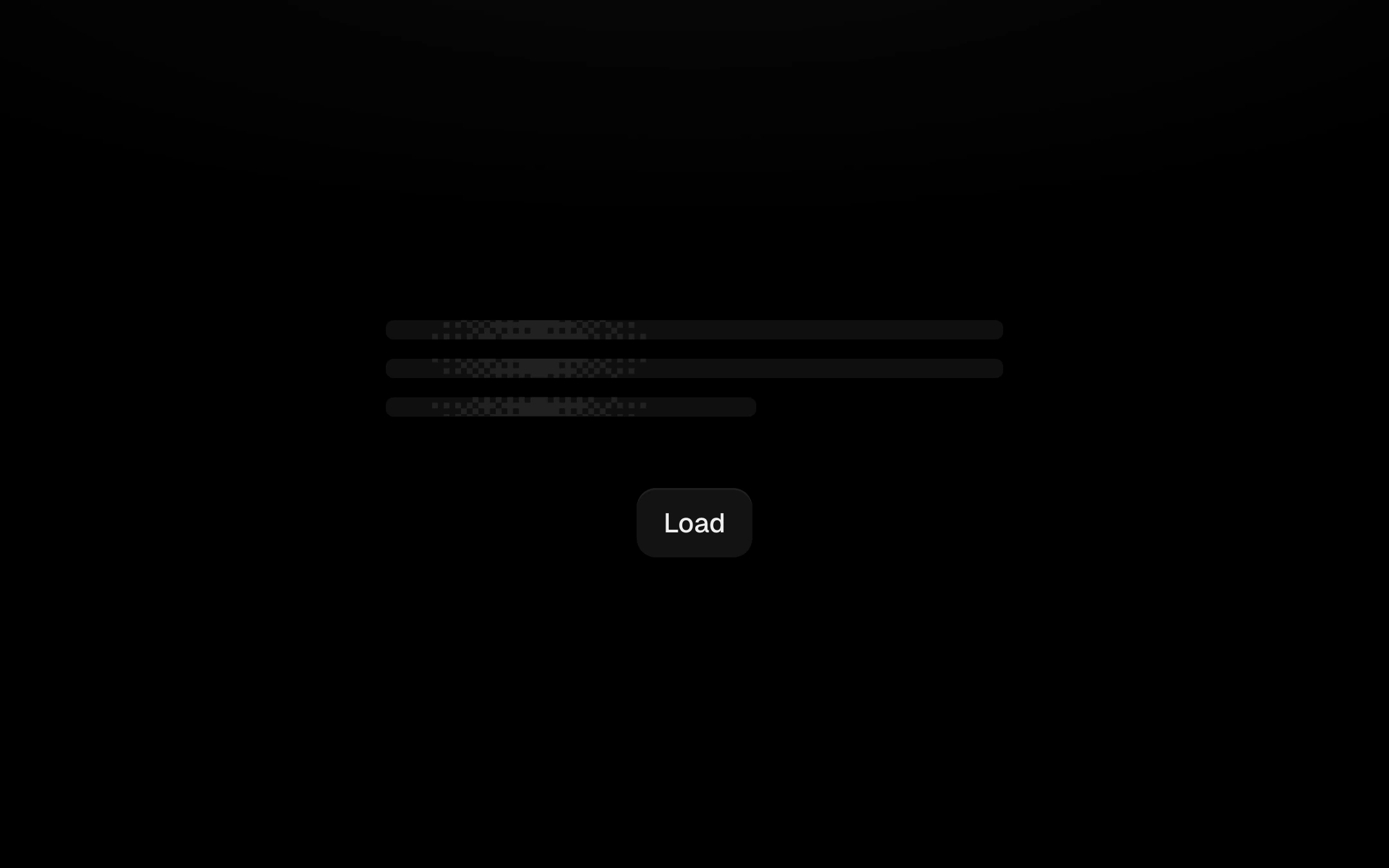
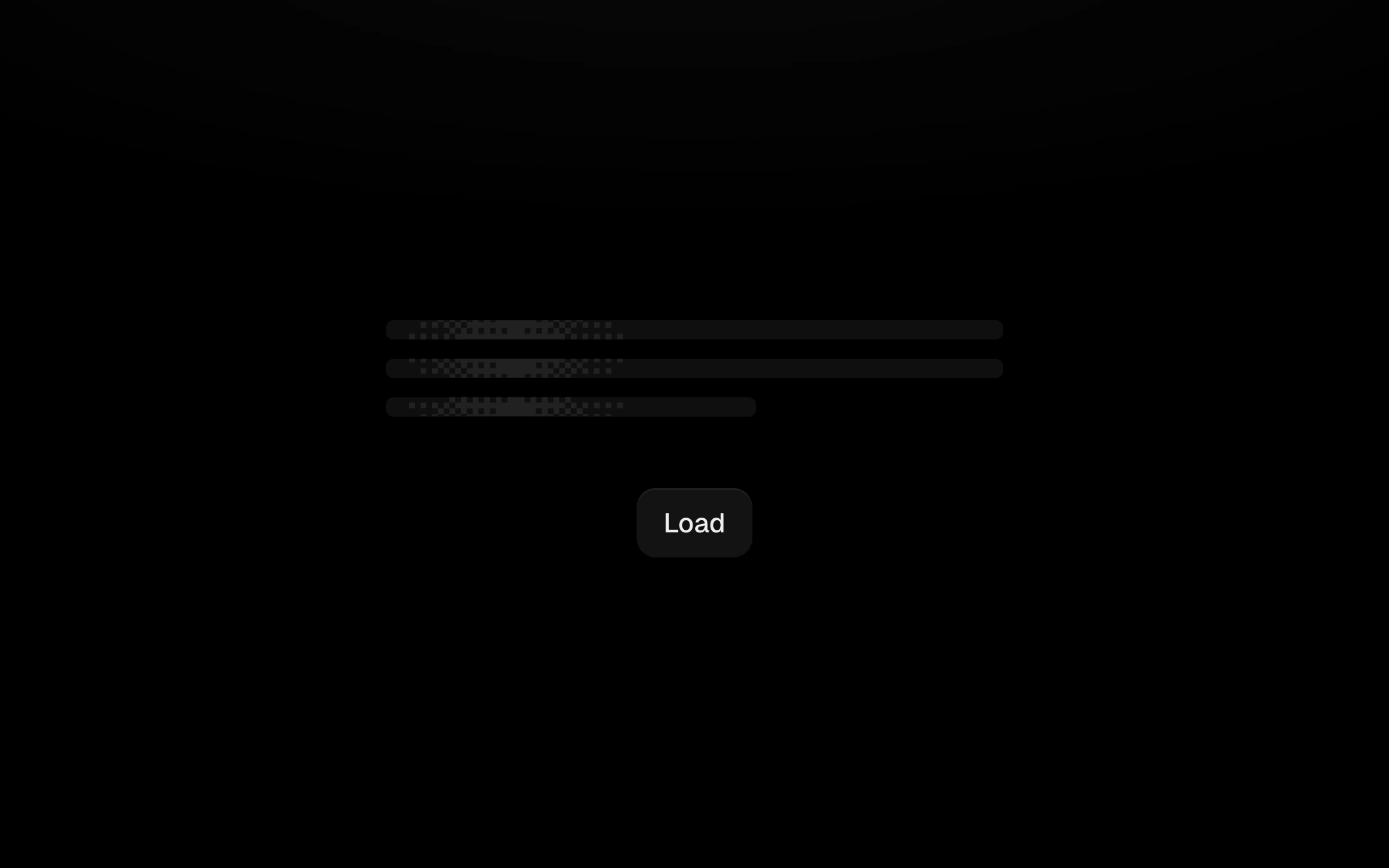
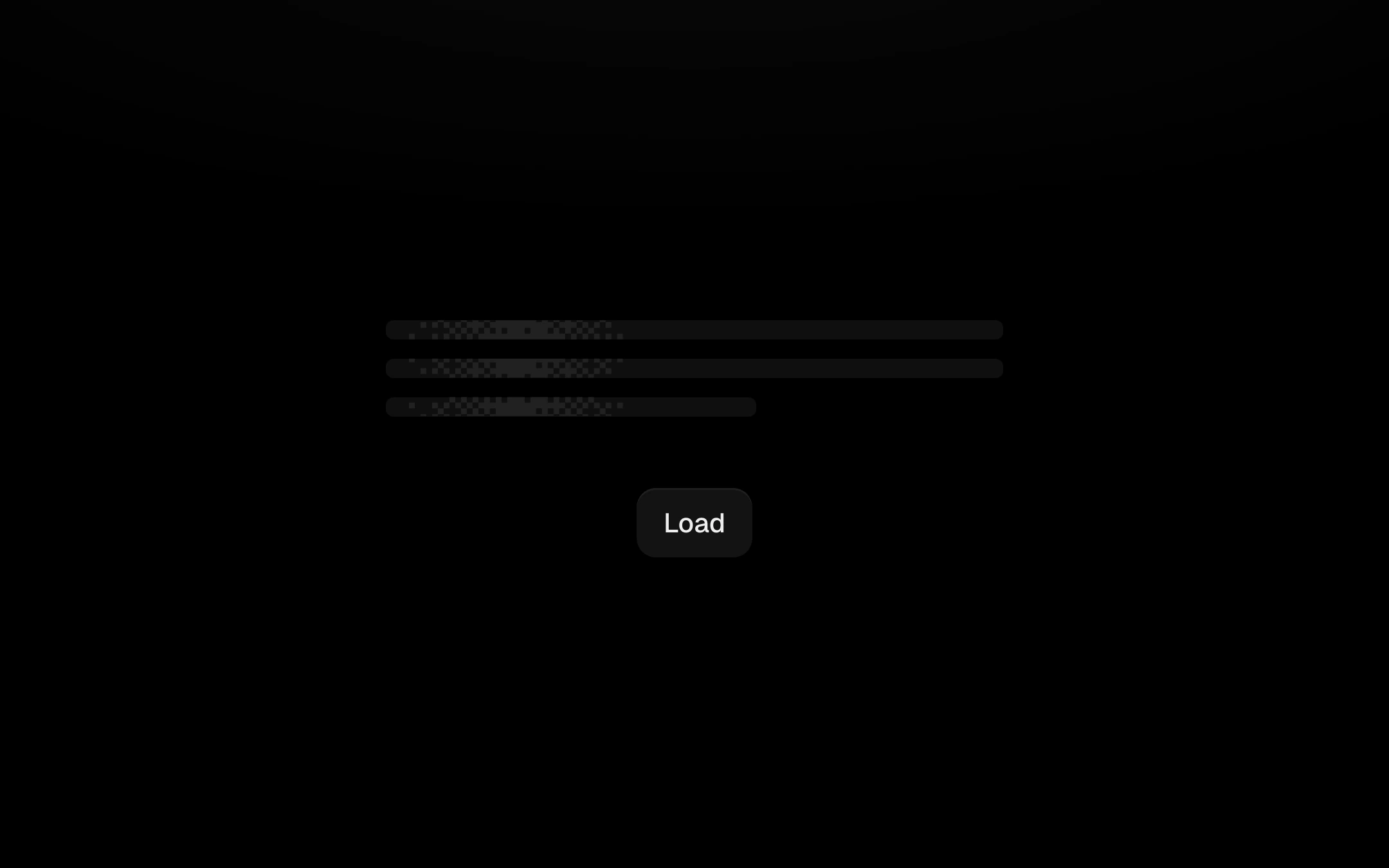
// Skeleton: a loading placeholder that shimmers in 1-bit ordered dither instead of a gradient.
// A 120px band sweeps every 1.6s on one page-wide clock; inside it 3px cells switch on by a
// Bayer 4×4 threshold that peaks at the band's centre. When loaded, the same threshold sweeps
// once (400ms) and swaps placeholder for content cell by cell, the front cells in the accent.
// Wrap several skeletons in <SkeletonGroup> to have one band (and one reveal) cross them all.

import { createContext, useContext, useEffect, useLayoutEffect, useRef, type CSSProperties, type ReactNode, type RefObject } from 'react';
import { createLoop } from '../shared/spring';
import { useOnScreen, useReducedMotion } from '../shared/chart-kit';
import { ACCENTS, resolveAccent, rgba, type Accent } from '../shared/accent';
import { bayer, clamp } from '../status-kit/kit';
import '../shared/ember.css';
import './skeleton.css';

export interface SkeletonProps {
  shape?: 'text' | 'block' | 'circle';
  /** Text only. The last line is 60% wide. */
  lines?: number;
  width?: number | string;
  height?: number | string;
  loaded?: boolean;
  /** The real content, shown when `loaded`. It shares the placeholder's box, so nothing shifts. */
  children?: ReactNode;
  accent?: Accent;
  className?: string;
  style?: CSSProperties;
}

const CELL = 3;
const BAND = 120;
const PERIOD_MS = 1600;
const REVEAL_MS = 400;
const RAMP = 48; // width of the dithered front during the reveal
const BASE_A = 0.06;
const LIT_A = (0.13 - BASE_A) / (1 - BASE_A); // drawn over the 6% shape, the cell reads as 13%

const ScopeContext = createContext<RefObject<HTMLElement | null> | null>(null);

/** Shares one sweep (shimmer band and reveal front) across every Skeleton inside it. */
export function SkeletonGroup({ children, className, style }: { children: ReactNode; className?: string; style?: CSSProperties }) {
  const ref = useRef<HTMLDivElement>(null);
  return (
    <ScopeContext.Provider value={ref}>
      <div ref={ref} className={className} style={style}>
        {children}
      </div>
    </ScopeContext.Provider>
  );
}

interface ShapeRect {
  x: number;
  y: number;
  w: number;
  h: number;
  round: boolean;
}

const px = (v: number | string | undefined) => (typeof v === 'number' ? `${v}px` : v);

export function Skeleton({
  shape = 'text',
  lines = 3,
  width,
  height,
  loaded = false,
  children,
  accent: accentProp,
  className,
  style,
}: SkeletonProps) {
  const accent = resolveAccent(accentProp);
  const reduced = useReducedMotion();
  const scopeRef = useContext(ScopeContext);
  const rootRef = useRef<HTMLDivElement>(null);
  const phRef = useRef<HTMLDivElement>(null);
  const contentRef = useRef<HTMLDivElement>(null);
  const canvasRef = useRef<HTMLCanvasElement>(null);
  const onScreen = useOnScreen(rootRef);
  const reducedRef = useRef(reduced);
  reducedRef.current = reduced;

  const s = useRef({
    shapes: [] as ShapeRect[],
    mode: (loaded ? 'done' : 'loading') as 'loading' | 'reveal' | 'done',
    revealAt: 0,
    accent,
  });
  s.current.accent = accent;

  const measureShapes = () => {
    const ph = phRef.current;
    if (!ph) return;
    s.current.shapes = Array.from(ph.querySelectorAll<HTMLElement>('.esk-shape')).map((el) => ({
      x: el.offsetLeft,
      y: el.offsetTop,
      w: el.offsetWidth,
      h: el.offsetHeight,
      round: el.classList.contains('esk-circle'),
    }));
  };

  /** Applies the clip that shows content where the front has passed and the placeholder elsewhere. */
  const setClips = (contentClip: string | null, phClip: string | null) => {
    const c = contentRef.current;
    const p = phRef.current;
    if (c) c.style.clipPath = contentClip ?? '';
    if (p) p.style.clipPath = phClip ?? '';
  };

  const frame = (now: number): boolean => {
    const root = rootRef.current;
    const canvas = canvasRef.current;
    if (!root || !canvas) return false;
    const st = s.current;
    const dpr = window.devicePixelRatio || 1;
    const rr = root.getBoundingClientRect();
    const scopeEl = scopeRef?.current ?? root;
    const sr = scopeEl === root ? rr : scopeEl.getBoundingClientRect();
    const W = rr.width;
    const H = rr.height;

    // Canvas origin on a whole device pixel so 3px cells land on device pixels.
    const devL = Math.floor(rr.left * dpr);
    const devT = Math.floor(rr.top * dpr);
    const fx = rr.left * dpr - devL;
    const fy = rr.top * dpr - devT;
    const bw = Math.ceil(W * dpr + fx) + 1;
    const bh = Math.ceil(H * dpr + fy) + 1;
    if (canvas.width !== bw) canvas.width = bw;
    if (canvas.height !== bh) canvas.height = bh;
    canvas.style.width = `${bw / dpr}px`;
    canvas.style.height = `${bh / dpr}px`;
    canvas.style.transform = `translate(${-fx / dpr}px, ${-fy / dpr}px)`;
    const ctx = canvas.getContext('2d')!;
    ctx.setTransform(1, 0, 0, 1, 0, 0);
    ctx.clearRect(0, 0, bw, bh);

    // Scope coordinates (CSS px) → this canvas (device px).
    const ox = sr.left - rr.left;
    const oy = sr.top - rr.top;
    const toDevX = (sx: number) => Math.round((sx + ox) * dpr + fx);
    const toDevY = (sy: number) => Math.round((sy + oy) * dpr + fy);

    // Cell range covering this skeleton, in scope cells.
    const k0 = Math.floor(-ox / CELL);
    const k1 = Math.ceil((W - ox) / CELL);
    const j0 = Math.floor(-oy / CELL);
    const j1 = Math.ceil((H - oy) / CELL);

    const clipShapes = () => {
      ctx.beginPath();
      for (const r of st.shapes) {
        const x = r.x * dpr + fx;
        const y = r.y * dpr + fy;
        if (r.round) {
          ctx.moveTo(x + r.w * dpr, y + (r.h * dpr) / 2);
          ctx.ellipse(x + (r.w * dpr) / 2, y + (r.h * dpr) / 2, (r.w * dpr) / 2, (r.h * dpr) / 2, 0, 0, Math.PI * 2);
        } else {
          ctx.roundRect(x, y, r.w * dpr, r.h * dpr, 4 * dpr);
        }
      }
      ctx.clip();
    };

    if (st.mode === 'loading') {
      const t = (now % PERIOD_MS) / PERIOD_MS;
      const span = sr.width + BAND;
      const bx = -BAND / 2 + t * span;
      const ka = Math.max(k0, Math.floor((bx - BAND / 2) / CELL));
      const kb = Math.min(k1, Math.ceil((bx + BAND / 2) / CELL));
      if (kb >= ka) {
        ctx.save();
        clipShapes();
        ctx.fillStyle = `rgba(255,255,255,${LIT_A})`;
        for (let k = ka; k <= kb; k++) {
          const i = 1 - Math.abs(k * CELL + CELL / 2 - bx) / (BAND / 2);
          if (i <= 0) continue;
          const x0 = toDevX(k * CELL);
          const x1 = toDevX((k + 1) * CELL);
          for (let j = j0; j <= j1; j++) {
            if (i > bayer(k, j)) {
              const y0 = toDevY(j * CELL);
              ctx.fillRect(x0, y0, x1 - x0, toDevY((j + 1) * CELL) - y0);
            }
          }
        }
        ctx.restore();
      }
      return true;
    }

    if (st.mode === 'reveal') {
      const p = clamp((now - st.revealAt) / REVEAL_MS, 0, 1);
      const front = -RAMP + p * (sr.width + RAMP * 2);
      // Local (CSS) coordinates of a scope cell edge, for the clip paths.
      const lx = (k: number) => +(k * CELL + ox).toFixed(2);
      const ly = (j: number) => +(j * CELL + oy).toFixed(2);
      let shown = '';
      let hidden = '';
      ctx.save();
      clipShapes();
      ctx.fillStyle = rgba(ACCENTS[st.accent].base, 1);
      for (let j = j0; j <= j1; j++) {
        let runStart = k0;
        let runOn: boolean | null = null;
        const flush = (end: number) => {
          if (runOn === null) return;
          const seg = `M${lx(runStart)} ${ly(j)}H${lx(end)}V${ly(j + 1)}H${lx(runStart)}Z`;
          if (runOn) shown += seg;
          else hidden += seg;
        };
        for (let k = k0; k <= k1; k++) {
          const r = clamp((front - (k * CELL + CELL / 2)) / RAMP, 0, 1);
          const thr = bayer(k, j);
          const on = r > thr;
          if (on && r < 1 && r - thr < 0.3) {
            const x0 = toDevX(k * CELL);
            const y0 = toDevY(j * CELL);
            ctx.fillRect(x0, y0, toDevX((k + 1) * CELL) - x0, toDevY((j + 1) * CELL) - y0);
          }
          if (on !== runOn) {
            flush(k);
            runStart = k;
            runOn = on;
          }
        }
        flush(k1 + 1);
      }
      ctx.restore();
      if (p >= 1) {
        st.mode = 'done';
        setClips(null, null);
        root.dataset.state = 'done';
        ctx.clearRect(0, 0, bw, bh);
        return false;
      }
      setClips(`path('${shown || 'M0 0Z'}')`, `path('${hidden || 'M0 0Z'}')`);
      return true;
    }
    return false;
  };

  const loopRef = useRef<ReturnType<typeof createLoop> | null>(null);
  if (!loopRef.current) loopRef.current = createLoop((_dt, now) => frame(now));

  useLayoutEffect(() => {
    measureShapes();
    const ro = new ResizeObserver(() => {
      measureShapes();
      if (s.current.mode === 'loading' && !reducedRef.current) frame(performance.now());
    });
    if (rootRef.current) ro.observe(rootRef.current);
    return () => ro.disconnect();
    // eslint-disable-next-line react-hooks/exhaustive-deps
  }, [shape, lines]);

  // Loading ↔ loaded.
  const firstRun = useRef(true);
  useLayoutEffect(() => {
    const st = s.current;
    const root = rootRef.current!;
    const loop = loopRef.current!;
    const wasFirst = firstRun.current;
    firstRun.current = false;
    if (!loaded) {
      st.mode = 'loading';
      root.dataset.state = 'loading';
      setClips(null, null);
    } else if (st.mode === 'loading') {
      if (wasFirst || reduced || !onScreen) {
        st.mode = 'done';
        root.dataset.state = 'done';
        setClips(null, null);
      } else {
        st.mode = 'reveal';
        st.revealAt = performance.now();
        root.dataset.state = 'reveal';
      }
    }
    const animate = !reduced && onScreen && st.mode !== 'done';
    if (animate) loop.wake();
    else {
      loop.stop();
      if (st.mode === 'reveal') {
        st.mode = 'done';
        root.dataset.state = 'done';
        setClips(null, null);
      }
      const c = canvasRef.current;
      c?.getContext('2d')?.clearRect(0, 0, c.width, c.height);
    }
    // eslint-disable-next-line react-hooks/exhaustive-deps
  }, [loaded, reduced, onScreen]);

  useEffect(() => () => loopRef.current?.stop(), []);

  const boxW = width ?? (shape === 'circle' ? 40 : '100%');
  const boxH = height ?? (shape === 'circle' ? (typeof boxW === 'number' ? boxW : 40) : shape === 'block' ? 120 : undefined);
  const n = Math.max(1, Math.round(lines) || 1);

  return (
    <div
      ref={rootRef}
      className={className ? `ember esk ${className}` : 'ember esk'}
      data-accent={accent}
      data-shape={shape}
      data-state={loaded ? 'done' : 'loading'}
      aria-busy={!loaded}
      style={{ width: px(boxW), ...(shape === 'text' ? {} : { height: px(boxH) }), ...style }}
    >
      <div ref={phRef} className="esk-ph" aria-hidden="true">
        {shape === 'text' ? (
          Array.from({ length: n }, (_, i) => (
            <div key={i} className="esk-shape esk-line" style={i === n - 1 ? { width: '60%' } : undefined} />
          ))
        ) : (
          <div className={shape === 'circle' ? 'esk-shape esk-circle' : 'esk-shape esk-block'} />
        )}
      </div>
      <div ref={contentRef} className="esk-content">
        {children}
      </div>
      <canvas ref={canvasRef} className="esk-canvas" aria-hidden="true" />
    </div>
  );
}

export default Skeleton;
Customize
circle-text
text
block
012345678903
012345678900123456789001234567890120
Content shares the placeholder's box, so nothing shifts.
Install
npx shadcn@latest add https://obsydeui.com/r/skeleton.jsonUsage
Import it from where the CLI puts it, or copy the files below by hand.
import { Skeleton } from '@/components/obsyde/ember/skeleton/Skeleton';

export function Example() {
  return (
    <Skeleton />
  );
}
Files
Plain React, TypeScript and CSS. No dependencies. The download keeps these paths.
ember/skeleton/Skeleton.tsxcomponentember/skeleton/skeleton-demo.cssstylesember/skeleton/skeleton.cssstylesember/skeleton/SkeletonDemo.tsxdemoember/status-kit/kit.tssharedember/shared/chart-kit.tssharedember/shared/spring.tssharedember/shared/accent.tssharedember/shared/ember.cssshared
API
| Prop | Type | Default |
|---|---|---|
accentAccent | 'ember' | 'volt' | 'arc' | 'ember' |
layoutLayout | 'circle-text' | 'text' | 'block' | 'circle-text' |
linesLines | number | 3 |
heightBlock height | number | 120 |
loadedLoaded | boolean | false |